The 5 Moments for Hand Hygiene approach was designed by the World Health Organization to minimise the risk of transmission of microorganisms between a healthcare worker, the patient, and the environment.
On this page:
- The 5 Moments – infographic
- Moment 1 - Before touching a patient
- Moment 2 - Before a procedure
- Moment 3 - After a procedure or body fluid exposure risk
- Moment 4 - After touching a patient
- Moment 5 - After touching a patient's surroundings
The 5 Moments – infographic
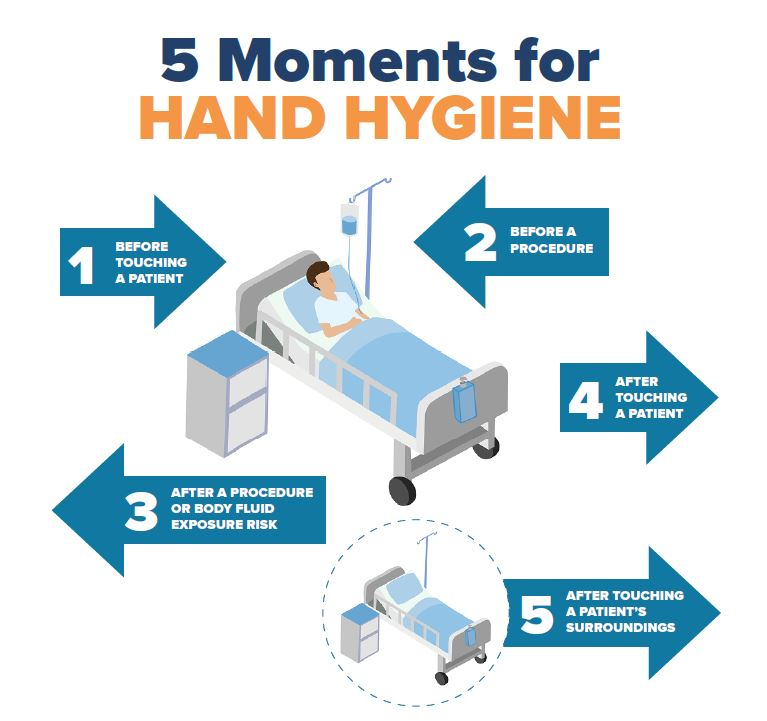
'Based on the 'My 5 moments for Hand Hygiene' © World Health Organization 2009. All rights reserved.'
Moment 1 - Before touching a patient
When
Immediately before touching the patient.
Why?
To protect the patient against microorganisms from the hands of the healthcare worker.
In detail
| Before touching a patient | Shaking hands, assisting a patient to move, allied health interventions, touching any medical device connected to the patient (for example, intravenous line pump, urinary catheter). |
|---|---|
| Before any personal care activities that require physical contact | Bathing, dressing, brushing hair, putting on personal aids such as glasses. |
| Before taking any non-invasive observations | Taking a pulse, blood pressure, oxygen saturation, temperature, chest auscultation, abdominal palpation, applying ECG electrodes, cardiotocography. |
| Before providing any non-invasive treatment | Applying an oxygen mask or nasal cannula, fitting slings/braces, application of incontinence aids (including condom drainage), conducting an oral examination without using a sharp instrument (such as using a mirror probe), performing oral X-ray. |
| Before the preparation or administration of oral medications | Oral medications, nebulised medications. |
| Before providing oral care and feeding | Feeding a patient (excluding feeding via nasogastric tube or percutaneous endoscopic gastrostomy), brushing teeth or dentures. |
Moment 2 - Before a procedure
When
Immediately before a procedure. Once hand hygiene has been performed, nothing else in the patient's environment should be touched prior to the procedure starting.
Why?
To protect the patient against microorganisms from entering the patient’s body, including the patient’s own microorganisms.
In detail
| Before inserting a needle into a patient’s skin or into an invasive medical device connected to the patient | Venepuncture, blood glucose level, arterial blood gas, subcutaneous or Intramuscular injections, intravenous line flush. |
|---|---|
| Before administration of any medications given via an invasive medical device | Intravenous medication, nasogastric tube (NGT) feeds, percutaneous endoscopic gastrostomy (PEG) feeds. |
| Before the preparation of an aseptic field | Dressing trolley set up for an aseptic procedure. |
| Before the administration of medications where there is direct or potentially direct contact with mucous membranes | Eye drop instillation, suppository insertion, vaginal pessary. |
| Before the insertion of, or contact with, an invasive medical device | Procedures involving endotracheal tube, tracheostomy, nasopharyngeal airways, suctioning of airways, urinary catheter, colostomy/ileostomy, vascular access systems, invasive monitoring devices, wound drains, percutaneous endoscopic gastrostomy tubes, nasogastric tube, secretion aspiration. |
| Before any assessment, treatment or patient care where contact is made with non-intact skin or mucous membranes or there is a likelihood of penetration of tissue or a cavity | Wound dressings, surgical procedures, digital rectal examination, invasive obstetric and gynaecological examinations and procedures, digital assessment of newborn palate, invasive dental examinations, dental extractions, dental restoration. |
| Before preparation and administration of any medications or materials for any oral health/dental procedure | Administering topical medication such as fluoride, topical anaesthetic, local anaesthetic or tooth mousse or restorative materials used for restoration procedure. |
Moment 3 - After a procedure or body fluid exposure risk
When
Immediately after a procedure or body fluid exposure risk.
Even if you have had gloves on you should still perform hand hygiene after removing them as gloves are not always a complete impermeable barrier. Hands may also have been contaminated in the process of removing the gloves.
Why?
To protect the healthcare worker and the healthcare environment from becoming contaminated with the patient's microorganisms.
In detail
| After performing a procedure | After insertion of a needle into a patient's skin or an invasive medical device. |
|---|---|
| After a potential body fluid exposure | Contact with a used urinary bottle/bedpan, contact with sputum either directly or indirectly via a cup or tissue, contact with used specimen jars/pathology samples, cleaning dentures, cleaning spills of body fluids from patient surroundings, after touching the outside of a wound or chest drain or oral suction tubing, contact with a used dental instruments or appliances, after touching surfaces that potentially contaminated with body fluid. |
Moment 4 - After touching a patient
When
After touching a patient.
Why
To protect the healthcare worker and the healthcare environment from becoming contaminated with the patient’s microorganisms.
| After a Moment 1, except if there has been exposure to body fluids | After touching a patient, after touching an intravenous pump or other medical equipment connected to the patient. |
|---|
Moment 5 - After touching a patient's surroundings
When
After touching anything in the patient's surroundings when the patient has not been touched or is not present.
Always hand hygiene before leaving the patient's room.
Why?
To protect the healthcare worker and the healthcare environment from becoming contaminated with the patient’s microorganisms.
In detail
| After touching any items in the patient zone but the patient has not been touched while the healthcare worker was in the patient zone | Any items in the patient zone include bed, bedrails, linen, table, bedside chart, bedside locker, call bell/TV remote control, light switches, personal belongings (including books, mobility aids), chair, footstool, monkey bar that is attached to a patient’s bed |
|---|
Was this article helpful?
That’s Great!
Thank you for your feedback
Sorry! We couldn't be helpful
Thank you for your feedback
Feedback sent
We appreciate your effort and will try to fix the article